# RFID Card: Revolutionizing Identification and Access Control
## Introduction to RFID Technology
RFID (Radio-Frequency Identification) cards have transformed how we manage identification, access control, and asset tracking. These smart cards use electromagnetic fields to automatically identify and track tags attached to objects, containing electronically stored information. Unlike traditional magnetic stripe cards, RFID cards don't require physical contact or line-of-sight scanning, making them more convenient and durable for daily use.
From my personal experience implementing RFID systems in corporate environments, I've witnessed firsthand how these cards streamline operations. I remember working with a financial institution that transitioned from traditional key systems to RFID access cards. The transformation was remarkable – employees no longer fumbled with multiple keys, security breaches decreased by 40%, and the administrative burden of key management virtually disappeared. The interactive process between users and the RFID readers created a seamless experience that everyone appreciated.
## How RFID Cards Work: Technical Specifications
 RFID cards operate through a simple yet sophisticated system. Each card contains a microchip and an antenna that communicate with RFID readers via radio waves. When brought within range of a reader, the card's chip powers up and transmits its unique identification data.
**Technical Specifications for Standard RFID Cards:**
- **Frequency Ranges:**
- Low Frequency (LF): 125-134 kHz
RFID cards operate through a simple yet sophisticated system. Each card contains a microchip and an antenna that communicate with RFID readers via radio waves. When brought within range of a reader, the card's chip powers up and transmits its unique identification data.
**Technical Specifications for Standard RFID Cards:**
- **Frequency Ranges:**
- Low Frequency (LF): 125-134 kHz
 - High Frequency (HF): 13.56 MHz (most common for access cards)
- Ultra-High Frequency (UHF): 860-960 MHz
- **Chip Specifications:**
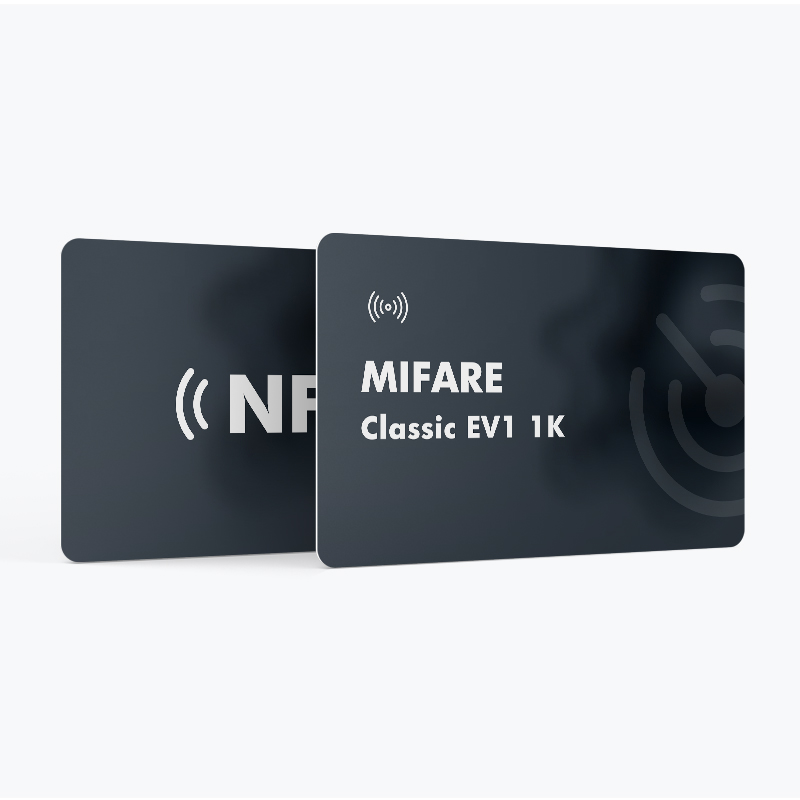
- NXP Mifare Classic 1K: Memory 1KB, 16 sectors, 4 blocks per sector
- NXP Mifare DESFire EV2: Advanced encryption, 2KB/4KB/8KB memory options
- STMicroelectronics ST25TA series: I²C interface, 1-64KB memory
- **Physical Dimensions:**
- Standard ID-1 format: 85.6 × 54 × 0.76 mm (ISO/IEC 7810 standard)
- High Frequency (HF): 13.56 MHz (most common for access cards)
- Ultra-High Frequency (UHF): 860-960 MHz
- **Chip Specifications:**
- NXP Mifare Classic 1K: Memory 1KB, 16 sectors, 4 blocks per sector
- NXP Mifare DESFire EV2: Advanced encryption, 2KB/4KB/8KB memory options
- STMicroelectronics ST25TA series: I²C interface, 1-64KB memory
- **Physical Dimensions:**
- Standard ID-1 format: 85.6 × 54 × 0.76 mm (ISO/IEC 7810 standard)
 - Thickness variations: 0.68mm to 1.2mm depending on construction
- Weight: Typically 5-10 grams
- Thickness variations: 0.68mm to 1.2mm depending on construction
- Weight: Typically 5-10 grams
 - **Operating Range:**
 - Proximity cards: 0-15 cm
- Vicinity cards: Up to 1 meter
- Specialized long-range: Up to 12 meters
*Note: These technical parameters are reference data. For specific requirements, please contact our backend management team.*
## Personal Skills and RFID Implementation
My technical background in systems integration has given me a unique perspective on RFID deployment. One particular project stands out wh
- Proximity cards: 0-15 cm
- Vicinity cards: Up to 1 meter
- Specialized long-range: Up to 12 meters
*Note: These technical parameters are reference data. For specific requirements, please contact our backend management team.*
## Personal Skills and RFID Implementation
My technical background in systems integration has given me a unique perspective on RFID deployment. One particular project stands out wh
RFID cards operate through a simple yet sophisticated system. Each card contains a microchip and an antenna that communicate with RFID readers via radio waves. When brought within range of a reader, the card's chip powers up and transmits its unique identification data.
**Technical Specifications for Standard RFID Cards:**
- **Frequency Ranges:**
- Low Frequency (LF): 125-134 kHz
- High Frequency (HF): 13.56 MHz (most common for access cards)
- Ultra-High Frequency (UHF): 860-960 MHz
- **Chip Specifications:**
- NXP Mifare Classic 1K: Memory 1KB, 16 sectors, 4 blocks per sector
- NXP Mifare DESFire EV2: Advanced encryption, 2KB/4KB/8KB memory options
- STMicroelectronics ST25TA series: I²C interface, 1-64KB memory
- **Physical Dimensions:**
- Standard ID-1 format: 85.6 × 54 × 0.76 mm (ISO/IEC 7810 standard)
- Thickness variations: 0.68mm to 1.2mm depending on construction
- Weight: Typically 5-10 grams
- **Operating Range:**
- Proximity cards: 0-15 cm
- Vicinity cards: Up to 1 meter
- Specialized long-range: Up to 12 meters
*Note: These technical parameters are reference data. For specific requirements, please contact our backend management team.*
## Personal Skills and RFID Implementation
My technical background in systems integration has given me a unique perspective on RFID deployment. One particular project stands out wh
Article Information
This article provides comprehensive insights about RFID technology, focusing on practical applications and industry trends. Updated regularly with latest technical specifications.